
When should you perform maintenance on an industrial asset? For decades, the answer has often been based on time: inspect the equipment every month, replace a component every six months, or perform a major overhaul after a certain number of operating hours. But equipment doesn’t always fail because it has reached a particular age.
In complex industrial environments, about 11% of equipment failures are related to equipment life, while the remaining 89% occur randomly. In other words, the calendar alone may not tell you when an asset is going to fail.
So how can maintenance teams catch problems early enough to act? Increasingly, the answer is to supplement Time-Based Maintenance (TBM) with Condition-Based Maintenance (CBM) and Predictive Maintenance (PdM).
What Is Time-Based Maintenance?
Time-Based Maintenance (TBM) is a preventive maintenance strategy in which maintenance is performed at predetermined time or usage intervals.
For example:
- Inspect a pump every 30 days
- Lubricate a bearing every 1,000 operating hours
- Replace a filter every six months
TBM offers predictability. Teams can plan labor, spare parts, and production downtime. It can also be highly effective for components with predictable wear patterns or maintenance requirements.
However, a fixed maintenance interval has an inherent limitation. It assumes that time or usage provides a meaningful indication of equipment condition. For many failure modes, that assumption doesn’t hold.
The Challenge with Time-Based Maintenance
Consider two identical pumps. One may operate under relatively stable conditions. The other sees frequent swings in load, temperature, and pressure. After the same number of hours, their actual condition may be very different. A fixed schedule can’t account for that, which leads to two opposite problems:
Maintaining Equipment Too Early
Components get replaced because the calendar says so, even when they’re in good condition. This raises costs, ties up maintenance crews, and discards useful component life.
Discovering Problems Too Late
An asset can start deteriorating shortly after scheduled maintenance. If the problem goes undetected, it may keep developing until it triggers an alarm or causes a failure, even when early intervention could have prevented it.
What Is Condition-Based Maintenance?
Condition-Based Maintenance (CBM) uses the actual condition of equipment to help determine when maintenance is necessary. The question shifts from “How long has this equipment been operating?” to “What is this equipment telling us about its condition?”
Condition can be assessed through several groups of measurements:
- Physical and mechanical indicators: vibration, temperature, pressure, and flow
- Electrical indicators: current, voltage, and other electrical characteristics
- Fluid and lubricant indicators: lubricant condition and contamination
- Process and performance indicators: process variables and overall equipment performance
When these measurements show that an asset is deteriorating or behaving abnormally, teams can investigate and decide whether intervention is needed.
What Is Predictive Maintenance?
Predictive Maintenance (PdM) uses historical and real-time data to identify abnormal behavior and anticipate problems before they lead to failure.
Machine learning is what makes this approach practical at scale. Industrial equipment rarely operates in a static environment. Loads shift, processes change, and equipment interacts with other equipment, so defining every abnormal condition with fixed rules is difficult. Machine learning takes a different path: instead of relying on rules someone has to write in advance, it learns directly from the plant’s own operating history.
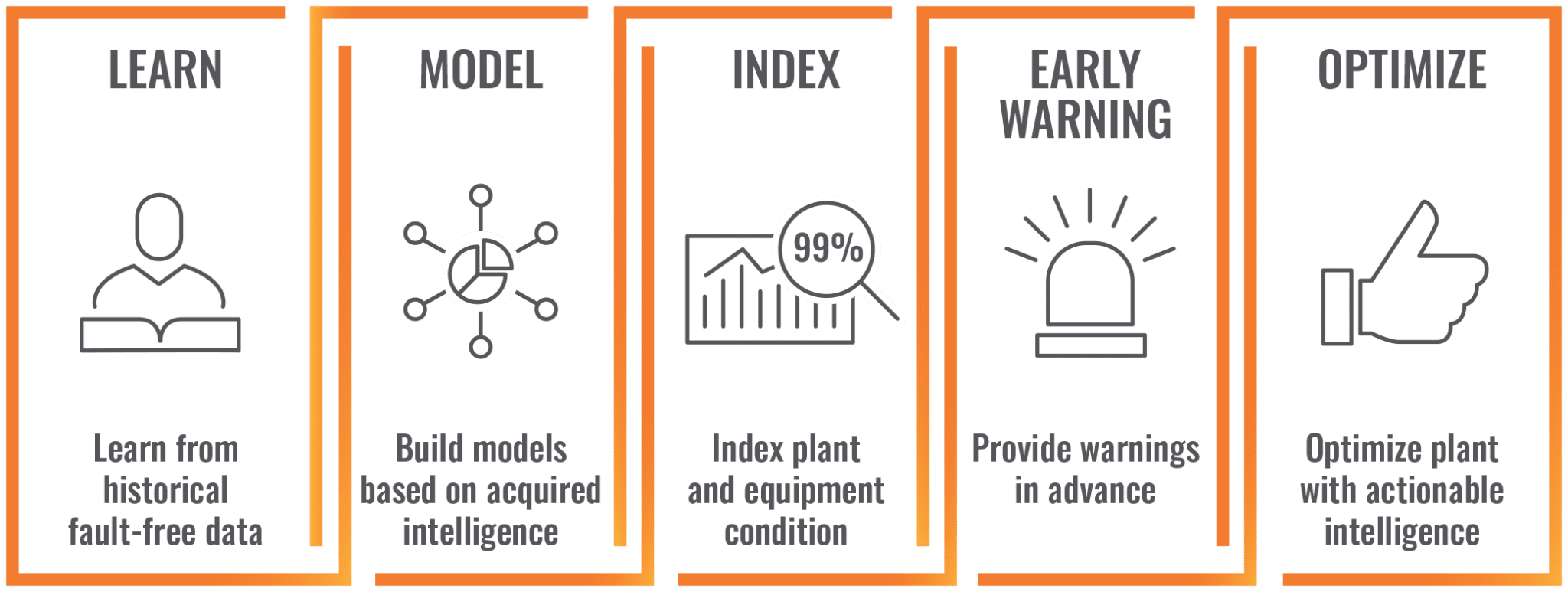
For example, HanAra’s HanPHI solution follows 5 stages:
- Learn. The system learns from historical, fault-free operating data, building an understanding of how equipment behaves when it’s healthy across a range of loads and operating conditions.
- Model. Using that acquired intelligence, the system builds models that capture how variables relate to one another to distinguish a normal operating change from a genuine abnormality.
- Index. Incoming real-time data is compared against those models to index plant and equipment condition, often as a simple health score that shows at a glance where attention is needed.
- Early Warning. When equipment begins drifting from its normal behavior, the system flags it in advance, often well before the issue is severe enough to trigger conventional DCS or PLC alarms, and highlights the variables contributing to the change.
- Optimize. With actionable intelligence on where a problem is developing and what’s driving it, teams can decide whether to monitor, inspect, or intervene, and optimize maintenance and plant operation over time.
Why Incorporate Both CBM and PdM?
Adding CBM and PdM doesn't mean abandoning preventive maintenance. It means bringing equipment condition and data-driven insight into maintenance decisions. Together, they help organizations:
- Detect problems earlier. Equipment issues often show up as subtle changes in temperature, pressure, vibration, or relationships between variables well before a failure.
- Improve plant stability. Catching developing problems early reduces unplanned downtime, production losses, and safety risks.
- Reduce unnecessary maintenance. Resources go to assets showing signs of deterioration, not to healthy equipment on a fixed schedule.
- Avoid costly major failures. Small problems addressed early don't become extensive repairs, long outages, or secondary damage.
A Maintenance Maturity Continuum
TBM, CBM, and PdM aren't competing approaches. They're stages on a path toward more data-driven maintenance with each stage building on the one before it.
- Reactive: "Fix it after it fails." Maintenance happens only after a breakdown, often at the highest cost.
- Time-Based: "Maintain it according to a schedule." Planned intervals bring predictability, but the schedule can't reflect actual equipment condition.
- Condition-Based: "Maintain it when its condition indicates a need." Monitoring data brings the equipment's actual state into maintenance decisions.
- Predictive: "Use data to identify abnormal behavior and anticipate problems." Machine learning and historical data reveal subtle changes before they become failures.
Moving along the continuum doesn't mean leaving earlier stages behind. Scheduled maintenance still has a place in a predictive program. What changes is how much insight guides each decision.
Each step forward depends more heavily on data. Condition-based maintenance needs reliable real-time measurements. Predictive maintenance needs historical data to learn what normal looks like. So the question for most plants isn't whether they're ready for predictive maintenance. It's whether their data is ready.
The Data Foundation
Most industrial facilities already generate enormous amounts of operational data from sensors, PLCs, DCS platforms, and monitoring systems. Often, though, that data is scattered across systems, stored in inconsistent formats, or not kept long enough to be useful for analysis.
An industrial data historian solves this by collecting, organizing, and preserving operational data from across the plant in one place. With a strong historian in place, teams can:
- Establish normal operating behavior
- Analyze how equipment behaves over time
- Compare current conditions with past performance
- Provide the historical data that machine learning models need to learn from
- Investigate the root causes of abnormal behavior
Without that foundation, even the most advanced analytics has nothing reliable to work with. With it, every stage of the continuum becomes more achievable, from better-informed scheduling to true predictive maintenance.
What Is Your Equipment Telling You?
The traditional question has been, "When is this equipment due for maintenance?" As plants collect more operational data, a better question emerges: "Is this equipment showing signs that it actually needs maintenance?"
Time remains important in maintenance planning. But time alone doesn't explain every failure. By combining reliable data, condition monitoring, and predictive analytics, teams can spot developing problems before they become costly failures.
The goal isn't more maintenance. It's smarter maintenance: the right maintenance on the right equipment at the right time.
How HanAra Supports Data-Driven Maintenance
HanAra's solutions help industrial organizations turn operational data into actionable information for equipment reliability and predictive maintenance. By combining industrial data management, historical and real-time analysis, and predictive analytics, HanAra helps teams gain visibility into equipment behavior, identify abnormal conditions early, and get more time to respond.
When equipment failure is hard to predict, equipment data may provide the warning the calendar can't. Learn more about HanAra's data management and predictive maintenance solutions.